
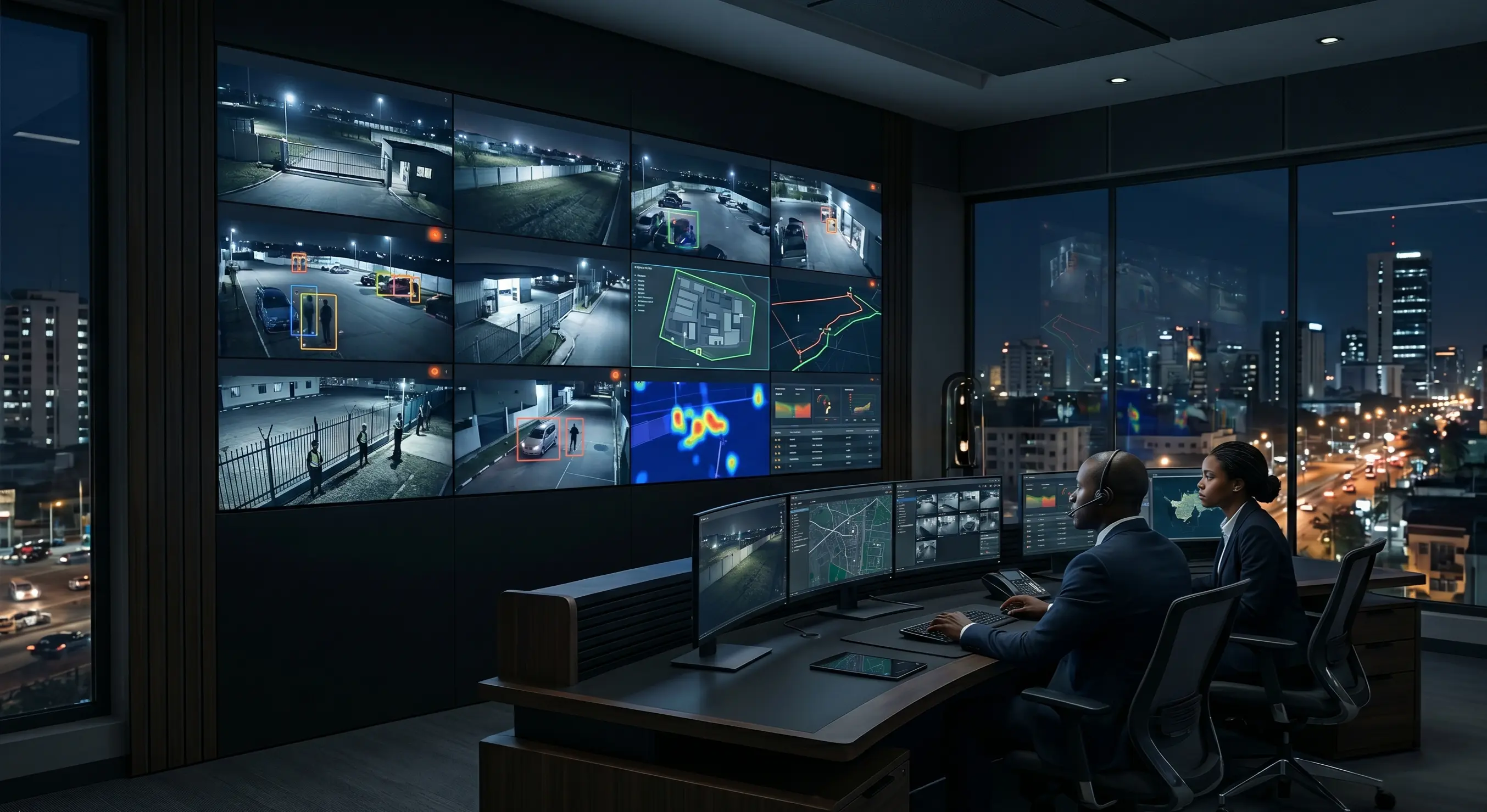
Computer Vision for Security Companies in Africa
Introduction
Computer vision for security companies in Africa is moving from a “nice-to-have” technology to a practical business tool. Security firms, estate managers, logistics operators, and industrial sites are all under pressure to improve monitoring while controlling costs, and computer vision offers a way to do both.
For Phobolytics Technologies, this is a strong fit because the company already positions itself around AI, computer vision, automation, and enterprise delivery. Public pages also show that Phobolytics serves clients across Africa and has delivered AI vision work in industrial and compliance-heavy environments, which supports this topic naturally.
A security company that still relies only on manual camera watching is working with limited speed and limited scale. Computer vision changes that by turning video into usable intelligence: alerts, detections, counts, classifications, and patterns that can be acted on immediately.
Why Africa matters
Africa is a strong market for security-focused computer vision because many organizations are dealing with high-traffic sites, expanding infrastructure, and growing expectations for faster incident response. Research from Africa-focused policy and research groups notes that computer vision and AI surveillance are already being deployed across the continent for safe-city initiatives, facial recognition, number plate recognition, and visual surveillance.
At the same time, there is still a gap between what businesses need and what they currently have. A lot of security operations are still reactive, which means the business finds out about a problem only after a human has seen it or after damage has already happened. Computer vision gives security teams a more proactive model.
This matters in cities such as Lagos, Johannesburg, Nairobi, Cape Town, Abuja, Accra, Kigali, Casablanca, and Dar es Salaam, where commercial activity, transport movement, estates, and industrial activity all create strong security demand. In these markets, a fast, reliable monitoring layer can create real business value.
What computer vision does
Computer vision is the part of AI that helps systems interpret images and video. In security operations, it can detect people, vehicles, movement, perimeter breaches, crowd density, safety violations, and suspicious behavior patterns. It can also help support face recognition, number plate recognition, and access control workflows where that is legally and operationally appropriate.
For a security company, this means the camera system stops being passive. Instead of recording events and waiting for someone to review them later, the system can trigger real-time alerts, flag incidents, and support faster response.
Security use cases
1. Perimeter monitoring
Computer vision can watch gates, fences, boundaries, and restricted zones for movement or intrusion. This is one of the clearest early wins because it reduces dependence on constant manual observation.
2. Crowd and occupancy monitoring
Security teams can count people, detect crowd buildup, and identify unusual congestion around entrances or sensitive areas. That is useful for estates, malls, events, campuses, and industrial sites.
3. Face recognition support
Where permitted, face recognition can support access control and identification workflows. Research in Africa has shown that facial recognition is already part of broader surveillance deployments, although governance and safeguards remain important.
4. Vehicle and number plate recognition
Computer vision can help identify vehicles entering or leaving a site, track movement patterns, and support gate logs. This is especially useful for logistics, compounds, and managed facilities.
5. Suspicious behavior detection
The system can flag loitering, unusual motion, boundary crossing, or repeated presence in restricted zones. This gives operators a better chance to act before an incident becomes serious.
6. Safety compliance monitoring
Security teams working in factories, construction sites, or industrial facilities can use computer vision to detect missing PPE, unsafe zones, or unauthorized activity. This overlaps security with compliance and workplace safety.
Where it adds value
The biggest value comes when the business has a lot of visual activity and not enough people to watch everything properly. That is why the strongest buyers are often:
Security companies.
Estates and property managers.
Warehouses and logistics firms.
Construction sites.
Retail chains.
Industrial plants.
Corporate campuses.
Smart-city and public-infrastructure teams.
In those environments, even a small reduction in response time can matter. If an incident is flagged earlier, the business can reduce damage, improve coordination, and make operations safer.
CCTV vs computer vision
Factor | Traditional CCTV | Computer vision |
|---|---|---|
Monitoring style | Passive recording | Active analysis |
Human effort | High | Lower after setup |
Alerts | Manual or limited | Real-time automated |
Scalability | Hard to monitor many feeds | Easier to scale across feeds |
Incident response | Slower | Faster |
Data value | Video archive | Video intelligence + alerts |
The point is not that CCTV is obsolete. The point is that computer vision makes CCTV smarter and more useful for operations and decision-making.
How to evaluate a solution
A good security computer vision solution should be judged by business outcomes, not buzzwords. Ask whether the system can actually reduce monitoring burden, improve detection speed, and integrate into current security workflows.
Use this checklist:
Define the exact security problem.
Choose one location or workflow.
Confirm the camera setup and video quality.
Decide what should trigger an alert.
Establish measurable success criteria.
Test the pilot in real conditions.
Review privacy, governance, and operational rules.
Plan support after launch.
Implementation framework
A practical rollout usually works in four stages.
Stage 1: Discovery
Map the site, the risks, the camera feeds, and the incident types you care about most.
Stage 2: Pilot
Start with one use case, such as intrusion detection or occupancy monitoring.
Stage 3: Validation
Review false alarms, missed events, operator workflow, and alert quality.
Stage 4: Scale
Expand to more sites, more camera zones, or more security functions after the pilot proves value.
Best practices
Start with one measurable security problem.
Use clear alert rules.
Keep human oversight in the workflow.
Integrate with existing CCTV rather than replacing everything at once.
Track false positives and false negatives.
Train operators on how to respond to alerts.
Design for local conditions, not generic lab conditions.
Common mistakes
The most common mistakes are predictable:
Buying AI before defining the security problem.
Using low-quality camera feeds.
Expecting perfect results immediately.
Ignoring response workflow.
Skipping support and maintenance.
Choosing a vendor that only sells demos, not deployment.
These mistakes waste budget and make the business think computer vision “didn’t work,” when the real issue was poor scope or poor implementation.
Why Phobolytics Technologies
Phobolytics Technologies is relevant here because its public positioning includes AI, computer vision, automation, and enterprise-grade delivery. The company also shows evidence of real project work in AI vision and industrial environments, which is exactly the kind of operational depth security buyers want.
The company’s delivery process page also suggests a structured implementation model: discovery, strategy, design, development, testing, deployment, and support. That matters because security buyers need continuity, not just a one-time prototype.
Phobolytics also presents a global delivery profile and Africa presence, which gives it a natural basis for serving security-focused organizations across African markets.
Featured paragraph
Computer vision for security companies in Africa helps teams monitor video feeds automatically, detect threats faster, improve perimeter security, and reduce manual review work. It is especially useful for CCTV analytics, access control, crowd monitoring, vehicle tracking, and industrial safety.
Real-world examples
A gated estate can use computer vision to detect repeated fence-line movement at night. A warehouse can use it to flag restricted-zone entry or missing safety gear. A retail chain can use it to monitor occupancy and suspicious activity across multiple branches. A security company can use it to reduce how many people are needed to watch live camera feeds.
The same logic applies to transport hubs, construction sites, and industrial plants where security and operations overlap. The more visual activity there is, the more value computer vision tends to create.
Decision framework
If you are deciding whether to adopt computer vision, ask three questions:
Is the problem visual?
Is manual monitoring too slow or too expensive?
Would earlier detection improve security or operations?
If the answer is yes to all three, the use case is probably strong enough for a pilot.
Supporting Articles
External authority references
Research ICT Africa – Work in progress on Computer Vision — Useful for the Africa surveillance and computer vision context.
Research ICT Africa – Africa’s expansion of AI surveillance — Good source for regional AI surveillance trends across Africa.
ESET – AI-Powered Cybersecurity for African Organizations — Helpful for the broader AI security and risk context.
ITWeb – AI-based computer vision technology — Strong example of operational and industrial computer vision use cases.
Phobolytics Technologies – Our Story — Brand reference if you want to cite company background.
Phobolytics Technologies – Process — Good for your implementation framework and delivery process.
FAQs
1. What is computer vision for security companies in Africa?
It is the use of AI to analyze camera feeds and detect events, threats, and patterns automatically.
2. Why is it useful for African security firms?
Because it helps reduce manual monitoring, improve response time, and scale across more camera feeds.
3. Can computer vision work with existing CCTV systems?
Often yes, if the camera setup and video quality are suitable for integration.
4. What are the best use cases?
Perimeter detection, crowd monitoring, access control, vehicle tracking, and suspicious behavior alerts.
5. Is face recognition always required?
No. Many security workflows work well without face recognition.
6. How expensive is it?
Cost depends on the scope, number of feeds, and level of integration.
7. Can it reduce security costs?
Yes, especially where it reduces manual monitoring or speeds up incident response.
8. What industries in Africa benefit most?
Security, logistics, retail, construction, real estate, and industrial operations.
9. How do we start?
Start with one clear problem and one pilot site.
10. What should we avoid?
Avoid vague requirements, low-quality camera input, and no-response workflows.
11. How long does a pilot take?
It depends on scope, but a focused pilot can be launched relatively quickly.
12. Is it suitable for small security companies?
Yes, if they start with one narrow use case.
13. Does it replace guards?
No. It supports guards and operators by improving detection and visibility.
14. Can it be customized for local operations?
Yes. That is often necessary for real-world success.
15. Why work with Phobolytics Technologies?
Because it combines AI, computer vision, delivery structure, and practical implementation experience.
Conclusion
Computer vision for security companies in Africa is not just a future idea. It is already being used to improve surveillance, automate alerts, and support smarter security operations across the continent. The businesses that benefit most are the ones that start with one real problem, build a focused pilot, and scale only after the system proves value.
Phobolytics Technologies is positioned to help with that transition because it already works in AI, computer vision, and enterprise delivery, with a process-oriented approach that fits security use cases well. If your goal is to improve monitoring, reduce operational drag, and strengthen security response, the next step is to define one site, one problem, and one measurable outcome.