
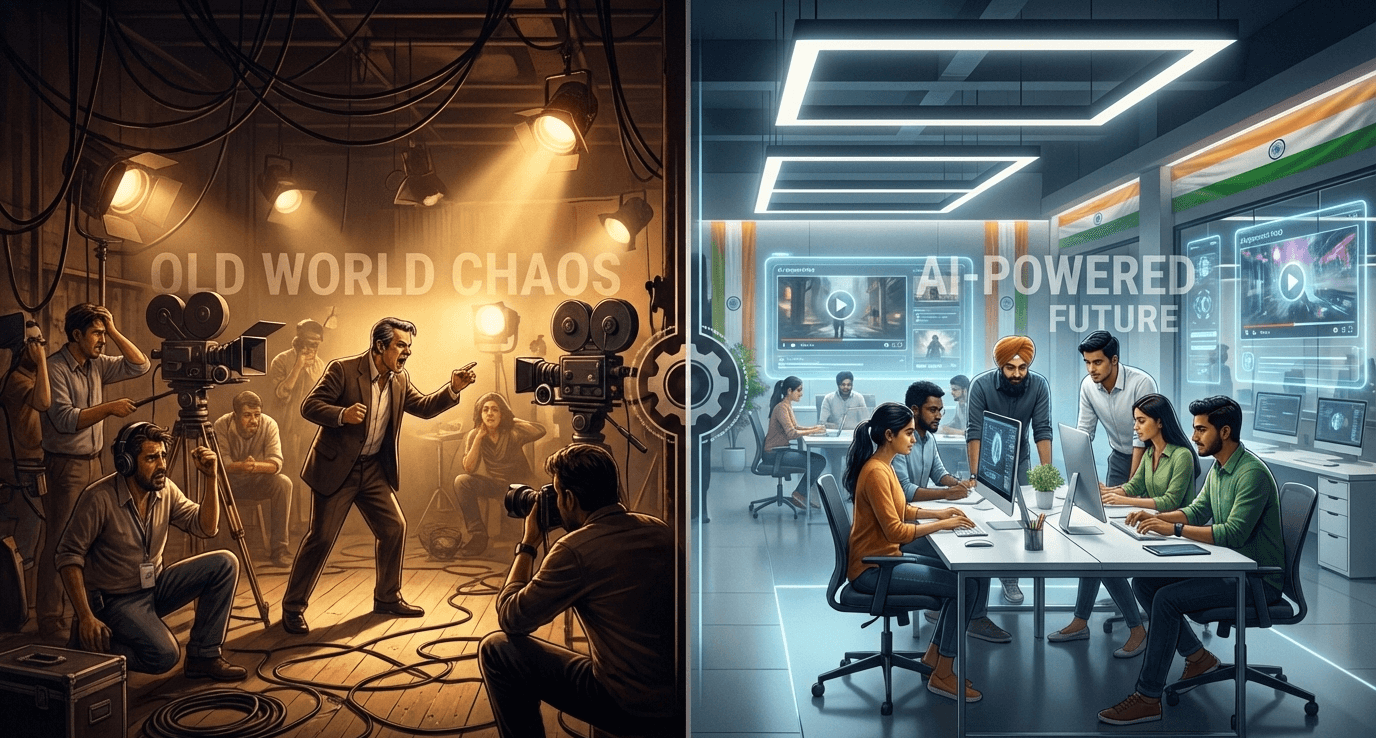
Seedance 2.0 vs Hollywood: Why AI Video Generation is India's Next Big Opportunity
Date: February 15, 2026 | Category: AI Innovation | Read Time: 10 Minutes
On February 10, 2026, China dropped a bombshell that sent shockwaves through Hollywood, Silicon Valley, and every creative industry on the planet.
Seedance 2.0—ByteDance's latest AI video generation model—went viral within 48 hours. Users created cinematic, Hollywood-quality video clips from simple text prompts. We're not talking about janky animations. We're talking about two-minute sequences with consistent characters, dramatic lighting, smooth camera movements, and storylines that look like they came from a $10 million production studio.
Elon Musk tweeted: "It's happening fast." And he's right.
But while Hollywood panics and America debates copyright law, there's a different question Indian entrepreneurs should be asking: "How do we win this race?"
What is Seedance 2.0 and Why is it Breaking the Internet?
Seedance 2.0 is ByteDance's (the company behind TikTok) latest generative AI model. Unlike earlier tools that produced short, choppy clips, Seedance 2.0 generates:
Long-form video sequences (up to 2 minutes) with narrative coherence
Consistent character design across multiple shots (no morphing faces mid-scene)
Cinematic camera work (dolly zooms, tracking shots, depth-of-field effects)
Multi-language support (including Mandarin, English, and more)
Within 24 hours of its limited beta release, social media exploded with examples. One viral clip featured AI-generated versions of rapper Ye (formerly Kanye West) and Kim Kardashian in an Imperial Chinese palace drama, speaking fluent Mandarin and singing.
Another showed Brad Pitt and Tom Cruise in a UFC-style fight sequence so realistic that it triggered copyright complaints from talent agencies.
The model is not yet publicly available in the US due to export restrictions, but it's already dominating feeds in China, India, and across Asia.
The "Hollywood Killer" Debate: Hype or Reality?
The phrase "Hollywood is in danger" is trending on X (formerly Twitter). But is it?
What Hollywood is Really Scared Of
It's not that AI will replace directors or actors tomorrow. The fear is more strategic:
Democratized Production: A 20-year-old in Mumbai with a laptop can now produce content that looks like a Netflix series—without a studio, without a crew, without permits.
Speed: Traditional filmmaking takes months. AI video generation takes minutes. For brands, advertisers, and content creators, speed = competitive advantage.
Cost Collapse: Why pay $500,000 for a 30-second commercial when an AI model can generate 100 variations for $50?
The Copyright Minefield
Legal experts are already raising red flags. When Seedance 2.0 generates a video of "Brad Pitt," whose intellectual property is that? The AI company? The user? Brad Pitt himself?
China's regulatory environment doesn't prioritize Western IP law the same way, giving Chinese AI companies a "move fast, worry about lawsuits later" advantage.
This creates a vacuum. And vacuums create opportunities.
Why India Should Care (And Act Fast)
India is uniquely positioned to lead the next wave of AI video generation—not by copying Seedance 2.0, but by building something fundamentally different.
The "Bharat-First" AI Video Model
While Seedance focuses on cinematic Hollywood-style content, India has different content needs:
Regional Language Content: India produces content in 22+ official languages. Imagine an AI model that generates Tamil, Telugu, Bengali, Marathi video ads automatically.
Cultural Context: AI trained on Indian festivals, mythology, and local aesthetics (not just Hollywood tropes).
Affordable Compute: Using Small Language Models (SLMs) instead of massive cloud-dependent systems, making it accessible to Tier-2 and Tier-3 creators.
According to EY India's recent report, 91% of Indian enterprises cite deployment speed as the key factor in AI adoption decisions. They don't want bleeding-edge Hollywood tech; they want fast, affordable, and localized solutions.
The Indian Advantage: Why We Can Win This Race
1. Talent Density
India has over 1.5 million AI professionals, many trained in computer vision, NLP, and generative models. Bangalore, Hyderabad, and Delhi are already AI hubs.
2. Content Hunger
India is the world's largest consumer of digital video content. YouTube India has 467 million users. Instagram Reels dominates mobile usage. The market is massive and underserved.
3. Sovereign AI Infrastructure
Unlike dependency on US-based cloud providers, India is investing in Sovereign AI—localized data centers, Indian-language models, and government-backed compute resources.
4. Regulatory Clarity (Eventually)
While the West debates AI regulation and China ignores it, India has the opportunity to build a balanced framework that protects creators while encouraging innovation.
From Assistive AI to Agentic AI: The Execution Revolution
Here's the bigger shift happening in 2026 that most people are missing:
AI is moving from "conversation" (chatbots that answer questions) to "execution" (agents that do the work).
2025 taught AI how to speak.
2026 is about getting work done.
This means:
AI doesn't just "suggest a video idea"—it generates the entire video, edits it, adds subtitles, and uploads it to YouTube.
AI doesn't just "recommend a marketing strategy"—it creates 50 variations, A/B tests them, and optimizes for conversions.
For Indian startups, this is the golden window. Build tools that execute, not just assist.
How Indian Startups Can Capture the AI Video Market
If you're a founder or developer reading this, here's your action plan:
1. Build for Bharat, Not Silicon Valley
Don't chase Hollywood aesthetics. Build for wedding videographers in Jaipur, SMB advertisers in Pune, and YouTube creators in Kochi.
2. Focus on Speed and Affordability
Indian users won't pay $50/month for video AI. But they'll pay ₹500 if it solves a painful problem (like creating 30 Instagram Reels in 10 minutes).
3. Partner with the Government
The India AI Impact Summit (happening Feb 19-20 in Delhi) is the perfect platform to showcase your solution to policymakers, investors, and enterprise buyers.
4. Prioritize Compliance Early
Don't ignore copyright and ethical AI concerns. Build watermarking, consent mechanisms, and transparency layers into your product from Day 1.
FAQ: The Burning Questions About AI Video
1. Will AI video replace human filmmakers and actors?
Not entirely. AI will augment creative work. Directors will become "AI Operators," and actors may license their digital likenesses. But storytelling, emotion, and human creativity remain irreplaceable—for now.
2. Is Seedance 2.0 available in India?
It's in limited beta. Full public release is expected later in February 2026, but geopolitical factors may delay or restrict access in certain markets.
3. Can Indian startups compete with ByteDance's resources?
Yes, by targeting underserved niches. ByteDance is building for the global market. Indian startups can dominate regional languages, cultural content, and affordable pricing tiers that ByteDance won't prioritize.
4. What are the legal risks of using AI-generated video commercially?
Currently, it's murky. If your AI generates content that resembles real people or copyrighted material, you could face lawsuits. Always use AI ethically and consult legal experts before commercial deployment.
Conclusion: India's Moment is Now
While Hollywood debates and America regulates, India has a 12-18 month window to build the AI video tools that will define the next decade of content creation.
The question isn't "Can we compete with China?" The question is: "Can we build something better for our own market first?"
Seedance 2.0 is a wake-up call. Not a threat—an invitation.
The race is on. Are you building?
Want to explore AI-powered video solutions for your business?
Talk to Phobolytics about how we're integrating Computer Vision and AI automation into real-world content workflows. Let's build India's AI future together.
Related Articles:
Reuters Coverage on Seedance 2.0
India Today Tech Analysis
EY India Agentic AI Report
Indian Startup Trends 2026