
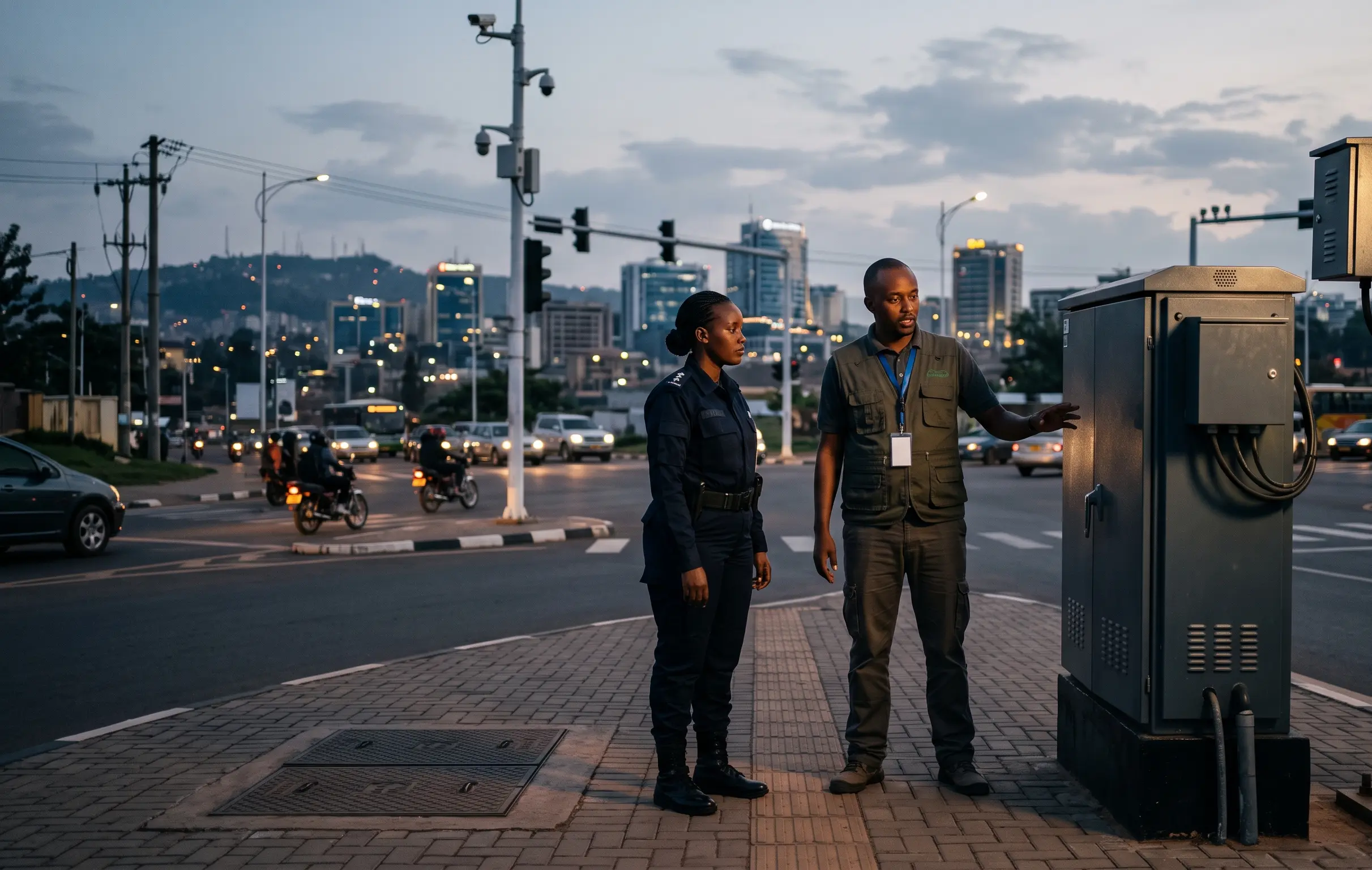
Computer Vision Company in Kigali: Proven 2026 Blueprint for Smart City Operations That Cannot Afford Blind Spots
A city operations supervisor in Kigali watched a junction back up for twenty minutes because the manual monitoring team missed a stalled vehicle in the bus lane. By the time the alert reached the control room, the queue had already spread into two adjacent roads, and the municipality had to reroute traffic during peak hours. The cost was not just congestion. It was fuel waste, delayed mobility, public frustration, and a report that made the city look behind its own smart city promise.
This is not a rare case. It is what happens when operations scale faster than oversight. A computer vision company in Kigali matters because smart city infrastructure only works when detection, response, and accountability move at the same speed as the city itself. Phobolytics looks at this problem as an operator would, by focusing on what the control room sees, what the street actually needs, and what failure costs when nobody notices it early enough.
Quick Answer
A computer vision company in Kigali helps smart city teams detect traffic issues, public safety risks, and perimeter events in real time. The best systems run on existing camera infrastructure and give city operators faster response without adding blind spots.
At a Glance
Yes, a computer vision company in Kigali can support traffic monitoring, crowd detection, and public safety alerts without replacing every camera on day one. The fastest wins usually come from edge AI at high-risk junctions and public zones.
The most effective way to improve smart city operations in Kigali is to connect computer vision alerts to the same control room that already handles traffic and safety decisions. That shortens response time and reduces the gap between detection and action.
In Rwanda, smart city work has to respect privacy, governance, and operational discipline at the same time. A computer vision company in Kigali is valuable when it helps operators improve safety without creating a surveillance system that people do not trust.
Why smart city operations in Rwanda have a visibility problem
Smart city projects in Kigali succeed only when the city can see, classify, and act on events before they spread. A computer vision company in Kigali solves the visibility gap because the failure modes are operational, not theoretical.
Manual patrols miss the moment congestion starts
A patrol team can only cover one area at a time, which means a stalled vehicle or illegal parking event can block a corridor for several minutes before anyone notices. On a busy Kigali artery, those minutes are enough to turn one lane problem into a citywide delay.
Static CCTV creates footage, not action
Traditional CCTV records incidents but does not interpret them. That means operators still need someone watching the feed in real time, and that person can only monitor so many screens before attention drops. The gap between seeing footage and understanding it is where city response fails.
Traffic teams lose time when alerts arrive late
If the control room gets a delay alert after the congestion has already spread, signal timing changes come too late. That creates a response loop where the city always reacts after the loss has already happened. A smart city needs early detection, not better post-incident reporting.
Public safety teams cannot scale manual observation
Manual observation works for a single event but breaks down when multiple zones need attention at once. A crowded market, a bus terminal, and a junction can all generate risk within the same ten-minute window. Without automated detection, one team has to choose which risk to ignore.
Ethical oversight matters as much as detection
Rwanda’s National AI Policy and UNESCO ethics work show that smart city systems must support accountability, privacy, and safe adoption. A computer vision company in Kigali has to respect that context by designing systems that support governance, not just surveillance.
Computer vision use cases for smart city Kigali in 2026
Computer vision company in Kigali deployments should map directly to the city operations that matter most: traffic, safety, mobility, and controlled access.
Traffic signal optimization at busy junctions
A camera at a congested Kigali junction can detect queue length, lane blockages, and abnormal stop time, then feed that data into a signal-control dashboard. At peak hours, that helps operators adjust timing before the whole corridor stalls. Does your current system detect congestion before it becomes a full roadblock?
ANPR for parking and access control
ANPR cameras at municipal car parks, government facilities, and event sites can read plates automatically and reduce manual gate checks. In a city like Kigali, that improves access control and reduces bottlenecks at entries where vehicles stack up. Can your current access system identify unauthorized vehicles within seconds?
Crowd density monitoring in public spaces
A vision system can estimate crowd density in markets, transit hubs, and event corridors to flag unsafe buildup before it becomes a safety issue. That gives control-room staff enough time to deploy personnel or reroute flow. Does your public safety team know when a crowd becomes too dense to manage safely?
Perimeter intrusion detection for critical sites
Smart city infrastructure includes assets such as water stations, control rooms, and utility compounds that need perimeter monitoring. Computer vision can detect movement in restricted zones and trigger response before theft or sabotage escalates. Can your current perimeter system tell the difference between routine movement and intrusion?
Night-time and low-light threat detection
Kigali’s public spaces and transport corridors still need reliable monitoring after dark. Low-light vision models help detect loitering, abandoned objects, and suspicious movement when human watchers miss detail. Can your team respond to a night-time anomaly within five minutes?
Public transport flow monitoring
Bus terminals and major road links need visibility into queue length, dwell time, and unsafe crossing behavior. A computer vision company in Kigali can help city operators manage public transport flow with data instead of guesswork. Does your mobility team see real-time terminal congestion or only end-of-day complaints?
Smart waste and illegal dumping monitoring
Vision systems can flag overflowing bins, illegal dumping, and sanitation issues in public zones. Kigali’s smart waste initiatives show that city operations already depend on better sensor-driven monitoring, and visual analytics extend that logic to street-level cleanliness. Can your current system detect waste overflow before residents report it?
What manual monitoring misses
Manual monitoring misses the speed, scale, and pattern recognition that smart city operations now require.
One operator cannot watch every screen
A control room may have dozens of feeds, but a human operator can only pay close attention to a small subset at any one moment. That means risks outside the operator’s focus window can sit unnoticed for several minutes or longer. The result is delayed intervention and avoidable congestion or exposure.
A delay of three minutes changes the outcome
In traffic management, three minutes is enough to convert a local incident into a corridor-wide delay. Once the queue spills into adjacent junctions, response becomes more expensive and less effective. Smart city operations need the alert when the problem starts, not after it spreads.
Footage review creates compliance gaps
When teams rely on after-the-fact review, they build reports from memory and archived video rather than from live decision data. That weakens incident reconstruction and can make accountability harder when city leaders ask what the control room knew and when. A recorded clip is not the same as a real-time decision trail.
Manual inspection does not scale with city growth
As Kigali adds more smart infrastructure, manual oversight costs rise faster than value. The city can add cameras, but it cannot add endless human attention at the same rate. That is why computer vision company in Kigali projects matter at the system level, not just the device level.
Three smart city approaches compared
Approach | Cost Profile | Coverage Capability | Primary Failure Mode | ROI Timeline |
|---|---|---|---|---|
Manual Monitoring | Low upfront cost, high staffing load | Limited to operator attention span | Missed events during busy periods | No reliable ROI, only operating cost |
Basic CCTV Without AI | Moderate hardware cost, no intelligence layer | Records footage but does not detect patterns | Footage exists, but action arrives late | Reactive only, no direct payback |
AI Computer Vision via Phobolytics | Project-based deployment on existing infrastructure | Detects traffic, crowd, perimeter, and access events in real time | Poorly defined alert rules if planning is rushed | 6 to 12 months for high-traffic sites |
Response Time | 5 to 20 minutes | Near real-time alerts | Under 2 seconds per event | Immediate operational gain |
Alert Accuracy | Human dependent | No classification | 95%+ with trained models and validation | Improves with calibration |
Scalability | Linear hiring growth | Expands across zones without proportional headcount | Control-room overload | Improves as more sites come online |
Regulatory Compliance Readiness | Manual logs only | No machine-generated trail | Time-stamped event records and audit logs | Immediate from launch |
Country and site variations
Smart city deployment patterns vary by city district, site type, and regulatory expectation. A computer vision company in Kigali must account for those local realities.
Kigali city center
Kigali city center has dense traffic corridors, administrative buildings, and public-facing facilities that need fast response and strong audit trails. The Smart City Rwanda Masterplan and the City of Kigali’s smart traffic initiatives make this a high-priority zone for intelligent transport and public safety analytics.
Kigali Innovation City
Kigali Innovation City brings together education, technology, and high-value commercial activity in one planned district. That means access control, crowd flow, and perimeter monitoring matter as much as traffic management. A computer vision company in Kigali can support a district like this with unified ANPR, face recognition, and intrusion detection.
Musanze and secondary urban zones
Secondary urban zones around Rwanda need different deployment assumptions because infrastructure density and staffing levels differ from the capital. Edge AI becomes more valuable where connectivity is less consistent and the city still wants reliable monitoring at public facilities and transport points. A smart city plan that ignores these zones becomes Kigali-only, not national.
Public transport corridors
Kigali’s corridor-based mobility projects depend on traffic prioritization, queue monitoring, and junction-level decision support. A camera system that only stores footage cannot help a city reroute buses or adjust signals in time. The mobility problem here is not the absence of cameras, it is the absence of usable intelligence.
How to deploy computer vision on an active smart city site
Deploying computer vision company in Kigali infrastructure on live city assets requires a staged operating model.
Map the city problem before choosing the camera. Define whether the issue is congestion, crowding, intrusion, or access control. If the problem is vague, the system will detect noise rather than risk.
Audit existing CCTV and sensor coverage. Identify where current cameras already give usable angles and where blind spots remain. Skipping this step leads to duplicate hardware spend and slower rollout.
Set event thresholds with city operators. Agree on what counts as congestion, intrusion, or crowd overload before the model goes live. If thresholds are left vague, the system will create alerts nobody trusts.
Deploy edge inference at critical nodes. Install local processing where internet reliability or latency could hurt response. If the city depends only on cloud processing, one network issue can delay the entire control loop.
Run a pilot at one junction or district first. Start with a single high-impact site and compare AI alerts against manual observation. If the city launches everywhere at once, it spreads risk instead of reducing it.
Integrate alerts into the existing control room workflow. Route warnings to the operators, supervisors, or dispatch teams already managing city responses. If alerts go to a separate screen, they become another unused dashboard.
Implementation checklist before you go live
Confirm that the camera angles cover every lane, entry point, or restricted zone in scope.
Verify that the site lighting supports clear detection during day and night conditions.
Test whether the system flags congestion, crowding, or intrusion at the thresholds agreed by city operators.
Confirm that the control room receives alerts inside the target response window.
Verify that edge devices continue running during unstable internet conditions.
Test whether the AI model recognizes the actual vehicle types, uniforms, or site layouts in Kigali.
Confirm that all alerts include timestamps and location tags for auditability.
Verify that the dashboard matches the workflow used by traffic or safety supervisors.
Test whether the fallback process still works if a sensor or camera fails.
Confirm that privacy, governance, and AI policy requirements are documented before launch.
Verify that maintenance staff know how to clean, inspect, and reboot each camera node.
Test whether the pilot data supports expansion before the city scales to additional zones.
Common mistakes when deploying computer vision
Treating a CCTV upgrade like a smart city system.
Footage storage alone does not improve response. If nobody gets a usable alert, the city still reacts too late. The correct approach is to design for detection, not just recording.Launching without a defined operational owner.
If the traffic team, safety team, and IT team all assume someone else owns the response, alerts die in the handoff. The correct approach is to assign one accountable operator per alert type.Ignoring Kigali-specific lighting and weather conditions.
A model trained on ideal footage will underperform in rain, night conditions, or glare. The correct approach is to test the system in the actual site environment before expansion.Adding too many zones before the first one works.
A rushed rollout across every junction turns one problem into ten small failures. The correct approach is to validate one district, then scale with evidence.The dashboard that nobody checks.
A well-built model can still fail if the alert goes to the wrong screen or the wrong shift. The correct approach is to tie alerts directly into the current control-room workflow.Skipping privacy and governance review.
Smart city systems without clear data rules create trust problems fast. The correct approach is to align the deployment with Rwanda’s AI policy, ethics guidance, and city governance expectations.
Why Phobolytics Technologies
Phobolytics Technologies fits the operational model that Kigali’s smart city teams need when they want better visibility without building a complicated surveillance stack from scratch. The practical value comes from three things that matter on real urban sites, not just in demos: computer vision on existing camera infrastructure without full hardware replacement, edge deployment for low or intermittent connectivity sites, and a unified system that can connect traffic monitoring, perimeter detection, access control, and public safety workflows in one platform.
That combination matters in Kigali because smart city work here is not only about detection, it is about trust, governance, and response speed. A city operations team cannot afford a system that looks intelligent on paper but fails when the network slows, the junction gets busy, or the alert lands in a queue nobody watches. The deployment model has to respect the city’s actual conditions, from traffic corridors and public spaces to government facilities and innovation districts.
Phobolytics approaches the problem as an operator would. It focuses on what the control room sees, what the field team can act on, and what the city can sustain without multiplying hardware costs or creating a second layer of manual work. For Kigali and similar African smart city environments, that is the difference between a technology purchase and a usable operations layer.
FAQs
Q: What is a computer vision company in Kigali?
A: A computer vision company in Kigali designs AI systems that help city operators detect traffic issues, safety risks, crowding, and access events using cameras and analytics. The useful version goes beyond recording video. It turns live footage into alerts, reports, and operational decisions that help control rooms respond faster and with less manual watching.
Q: How does computer vision help a smart city?
A: Computer vision helps a smart city by turning visual data into real-time operational signals. That can include queue buildup, illegal parking, crowd density, intrusion, and low-light threats. The main value is response speed. Instead of discovering incidents after the fact, city teams can act while the problem is still contained.
Q: What is the Smart Rwanda Master Plan?
A: The Smart Rwanda Master Plan is the national framework that guides Rwanda’s digital and urban development agenda. It gives cities like Kigali a structure for using ICT, data, and infrastructure to improve public services, mobility, and governance. Smart city computer vision projects work best when they align with that broader policy direction.
Q: How does AI traffic monitoring work in Kigali?
A: AI traffic monitoring uses cameras, edge processing, and event rules to detect congestion, blockages, and abnormal lane behavior. In Kigali, that means a system can flag problems at a junction before the queue spreads into adjacent roads. The control room then receives a usable alert instead of waiting for a complaint or delayed patrol report.
Q: Can smart city cameras work at night?
A: Yes, if the system uses the right optics, lighting assumptions, and low-light model tuning. Night monitoring matters in urban safety, transport, and perimeter use cases because many high-risk events happen after dark. A well-configured system can still detect motion, parked vehicles, and crowd buildup in low-light conditions.
Q: How long does it take to deploy a computer vision system in a city?
A: A small pilot at one junction or public site can be deployed in a few weeks if the camera infrastructure already exists. Larger smart city rollouts take longer because they require policy review, workflow integration, and validation. The fastest progress usually comes from starting with one high-impact zone and scaling from evidence.
Q: Is edge AI better for Kigali infrastructure?
A: Edge AI is often better when response speed matters or internet connectivity is not fully reliable. It processes video locally, which reduces latency and keeps the system running even if the network drops. For Kigali infrastructure, that makes edge deployment a practical choice for traffic control, public safety, and access monitoring.
Q: What is the ROI of smart city computer vision?
A: The ROI comes from reduced congestion, faster incident response, lower manual monitoring cost, and fewer missed events. If a control room can detect and clear a traffic problem even ten minutes earlier, the city saves time, fuel, and public frustration. The value is highest in busy corridors and high-risk public spaces.
Q: How does this fit Rwanda’s AI policy?
A: Rwanda’s AI policy and UNESCO ethics work require systems that support accountability, privacy, and responsible use. That means a computer vision project in Kigali should not just detect events, it should also produce clear logs, defined ownership, and governance-compatible workflows. The policy context matters as much as the technical model.
Q: Can a computer vision company in Kigali support public safety?
A: Yes, especially in crowd detection, low-light monitoring, perimeter intrusion, and abandoned object detection. Those use cases help public safety teams respond before small issues turn into incidents. The best results come when the system feeds a control room or dispatch team that already handles response duties.
Q: Can Phobolytics support smart city projects in Kigali?
A: Yes, Phobolytics can support smart city deployments that need traffic monitoring, access control, crowd analytics, or public safety alerts. The model fits sites that want to reuse existing cameras and add edge AI where needed. That gives city teams a practical way to improve visibility without overbuilding hardware.
Q: What makes Phobolytics different for Kigali projects?
A: Phobolytics focuses on deployment models that work in real site conditions, not just demos. That includes existing camera integration, edge processing for unreliable connectivity, and cross-use-case systems that can handle traffic, safety, and access control together. For Kigali, that matters because smart city work has to stay operational under real constraints.
Q: What should I check before deploying AI in a smart city zone?
A: Check camera angle, lighting, response ownership, alert routing, and governance alignment before deployment. A smart city zone fails when the alert reaches the wrong person or the system ignores local conditions like glare, rain, or network gaps. Validation on one site is better than a citywide rollout that nobody can manage.
Q: What city areas in Kigali are best for AI monitoring?
A: High-traffic junctions, transport corridors, public facilities, and innovation districts are the strongest candidates. Those areas create repeated, visible operational events where analytics can prove value quickly. A computer vision company in Kigali should start where the city already feels the cost of poor visibility.
Q: How does AI improve traffic flow in Kigali?
A: AI improves traffic flow by detecting queues, blockages, and abnormal stop times before the problem spreads. Once the system identifies the issue, operators can adjust signals or reroute vehicles faster. That reduces congestion, protects commute time, and gives city leaders better control over mobility outcomes.
CONCLUSION
The next 12 months will separate smart city projects that use data from those that only collect it. Cities that act now will reduce blind spots, improve response time, and build public trust around safer streets and better mobility. Cities that wait will keep paying for the same delay in different forms: congestion, missed incidents, and weak accountability.
A computer vision company in Kigali should not be judged by how much footage it stores. It should be judged by whether it helps operators make faster decisions at the exact point where a corridor, a junction, or a public space starts to fail. That is the difference between a city that looks smart and one that actually behaves that way.
Waiting carries a measurable cost: the incident that could have been contained becomes the corridor that stalls, the crowd that grows too dense, or the alert that arrives after the window to act has already closed. Speak to Phobolytics Technologies contact page to plan the next step.
Supporting Blogs
Computer vision for industrial operations in Johannesburg: Useful for city-adjacent industrial zones that need structured video analytics and operational monitoring.
AI computer vision for smart city and public safety surveillance: Directly supports public safety and surveillance use cases relevant to Kigali’s urban systems.
computer vision reducing losses in African logistics and fleet operations: Relevant for public transport corridors, fleet gates, and mobility-linked operations.
ROI from AI-powered automation versus manual workflows: Supports the business case for replacing manual watch duties with automated alerts.
computer vision for Lagos security and business automation: Useful as a parallel urban deployment reference for security and city monitoring.
External Authorities
UN-Habitat Smart City Rwanda Masterplan: Kigali smart city governance and urban planning context.
Rwanda Ministry of ICT AI Policy: Best source for Rwanda’s AI governance direction and ethical deployment expectations.
UNESCO Rwanda ethics of AI article: Supports the ethics, privacy, and accountability framing.
African Development Bank infrastructure reports: Useful for broader city infrastructure investment and smart urban growth context.
TechCabal African tech coverage: Best for regional adoption and investor-facing smart city and tech ecosystem references.