
Table of contents
Introduction.
What computer vision services mean for Nairobi businesses.
Why Nairobi is a strong market.
Industrial use cases in manufacturing and mining.
Comparison table: manual inspection vs computer vision.
How to choose the right provider.
Implementation framework.
Best practices.
Common mistakes.
Why Phobolytics Technologies.
FAQs.
Conclusion.
Introduction
Computer vision services in Nairobi are becoming increasingly relevant for manufacturing, mining, and other industrial businesses that want more control, better visibility, and faster decisions. When factories and industrial sites rely only on manual checks, they often lose time, miss defects, and struggle to maintain consistency.
For a business in Nairobi, computer vision is not just about cameras or fancy AI. It is about practical industrial outcomes: reducing errors, monitoring operations, improving safety, and helping teams act faster. Phobolytics Technologies offers AI and computer vision capabilities that fit this exact kind of use case, and its public positioning already includes computer vision, automation, and scalable tech delivery.
Nairobi is a strong place for this kind of work because the city has a growing ecosystem of software, AI, and industrial service providers. Public directories and job listings show active computer vision demand in Kenya, and Nairobi is clearly part of that market activity.
Why Nairobi is a strong market
Nairobi has the kind of business environment where industrial automation can create immediate value. Manufacturing and mining operations often deal with repetitive visual inspection, safety monitoring, movement tracking, and compliance tasks that are ideal for computer vision.
There is also a broader AI and software ecosystem in the city. Local providers are already offering AI and machine learning services in Nairobi, which means the market understands the language of automation and technical transformation.
For industrial buyers, this matters because it means computer vision is becoming more practical and easier to adopt. Businesses no longer need to treat it as a futuristic experiment; they can use it as a targeted operational tool.
What computer vision does in industry
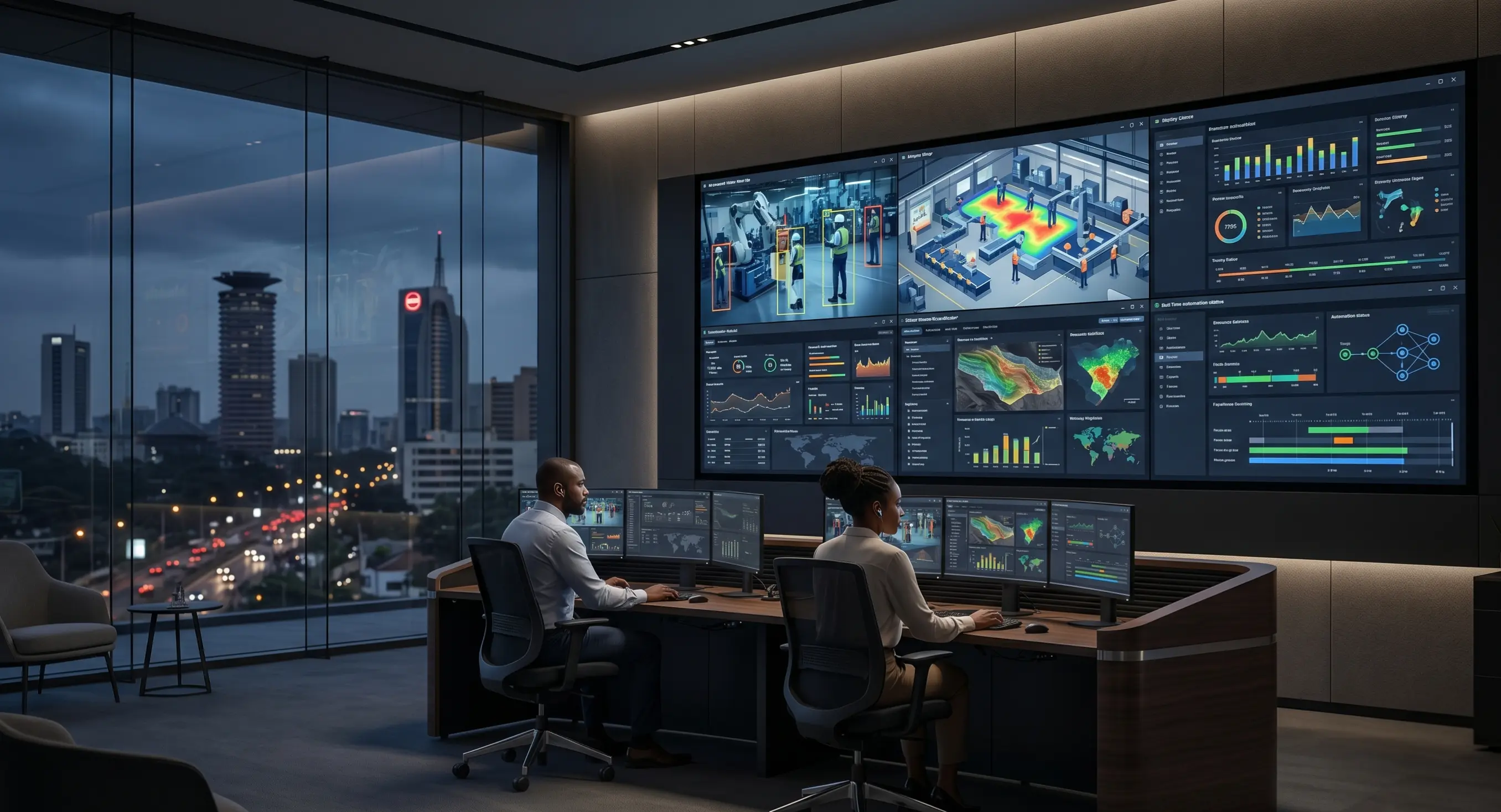
Computer vision lets machines interpret images and video to identify objects, detect anomalies, and support automated decisions. In industrial settings, that can include defect detection, safety checks, equipment monitoring, access control, and process verification.
For manufacturing, the value often comes from quality assurance and consistency. For mining, the value often comes from safety monitoring, movement oversight, and operational visibility. For other industries, the value may be in reducing manual inspection, improving throughput, or catching issues earlier.
Industrial use cases
1. Quality inspection in manufacturing
Factories can use computer vision to inspect products for defects, missing components, or irregular patterns. This is one of the clearest ROI areas because it reduces human error and speeds up quality control.
2. Safety monitoring in industrial sites
Computer vision can help detect missing protective gear, restricted-zone entry, and unsafe behavior. That is useful in plants, warehouses, and outdoor industrial sites where safety discipline matters.
3. Mining site monitoring
Mining businesses can use computer vision to improve oversight of site access, vehicle movement, worker activity, and safety conditions. The combination of scale and risk makes this a strong fit for automated visual monitoring.
4. Equipment and process monitoring
Vision systems can support status tracking for machines, production lines, and operational areas. That gives management better visibility into bottlenecks or unusual activity.
5. Access control and zone protection
Industrial businesses often need to control who enters specific areas. Computer vision can support gate monitoring, identity workflows, and restricted-area oversight.
Comparison table
Factor | Manual inspection | Computer vision |
|---|---|---|
Speed | Slower | Faster |
Consistency | Variable | More consistent |
Cost at scale | Higher | Lower over time |
Error rate | Higher | Lower when tuned well |
Coverage | Limited by staffing | Can cover more cameras and zones |
Reporting | Manual | Automated |
Best for | Small or low-automation settings | Industrial, multi-site, high-volume operations |
For many Nairobi industrial buyers, the transition starts with one repeatable process: quality checks, safety monitoring, or access monitoring. Once the pilot proves value, the system can expand.
Where computer vision adds the most value
The biggest value usually comes from tasks that are repetitive, visual, and costly when done manually. That makes manufacturing and mining natural fits, but it also extends to logistics, warehousing, plant management, and facility security.
If your team spends time looking at products, machines, people, or camera feeds, you probably have a use case. The more regular the visual task, the stronger the case for computer vision.
How to choose the right provider
A good provider should understand the industrial problem first and the AI second. Ask whether they can connect the vision system to your workflow, not just build a model.
Use this checklist:
Define the exact industrial problem.
Pick one process to automate first.
Check camera quality and site conditions.
Decide what should count as a defect, alert, or event.
Set measurable success criteria.
Run a pilot in a real environment.
Plan support and iteration.
Review business impact after launch.
Implementation framework
Stage 1: Discovery
Map the site, the process, and the key visual events.
Stage 2: Pilot
Start with one line, one zone, or one use case.
Stage 3: Evaluation
Review accuracy, false alarms, operator workflow, and reporting value.
Stage 4: Scale
Expand into more lines, more zones, or more facilities if the pilot proves useful.
Best practices
Start with a clear industrial outcome.
Use high-quality video input.
Keep humans in the loop early.
Focus on one workflow first.
Track measurable business value.
Train staff on how to use the alerts.
Make the system fit local site conditions.
Common mistakes
Asking for AI before defining the industrial problem.
Expecting perfect performance from a small pilot.
Ignoring poor camera placement.
Not planning maintenance or retraining.
Choosing the cheapest vendor instead of the best fit.
Treating computer vision as a one-time purchase instead of an ongoing system.
Why Phobolytics Technologies
Phobolytics Technologies is a logical fit for Nairobi industrial buyers because it already positions itself around AI, computer vision, and scalable tech delivery. The company also shows a structured process and broader project capability across AI and software work, which is important for industrial projects that need deployment, support, and iteration.
For businesses in manufacturing and mining, that kind of delivery structure is often more valuable than a generic software vendor. Industrial buyers need a partner that can understand the site, design the workflow, and stay involved after deployment.
Featured Summary
Computer vision services in Nairobi help manufacturing, mining, and industrial businesses automate visual inspection, improve safety monitoring, detect defects, and gain better operational visibility. They are most useful when a business has repetitive visual tasks that are slow, expensive, or error-prone when done manually.
Real-world examples
A manufacturer in Nairobi can use computer vision to detect product defects on the line before shipment. A mining business can use it to monitor access control and high-risk zones. A warehouse can use it to identify movement patterns and improve safety compliance. A plant operator can use it to reduce manual inspection time and improve response speed.
These examples are practical because they target workflows where a small improvement can have a large operational effect. That is usually where computer vision delivers the fastest return.
Decision framework
Ask yourself three questions:
Is the problem visual?
Is the process repetitive enough to automate?
Would faster detection improve cost, safety, or quality?
If the answer is yes, the use case is likely strong enough for a pilot. Contact us for a free demo.
Read these articles also:
Computer vision company in Lagos for security and business automation.
Dedicated AI engineers vs in-house hiring for African agencies.
External References
FAQs
1. What are computer vision services in Nairobi?
They are AI-based services that help businesses analyze images and video for automation, inspection, and monitoring.
2. Why are they useful for manufacturing?
They help improve quality control, reduce defects, and speed up inspection.
3. Can mining businesses use computer vision?
Yes. It can support monitoring, safety, access control, and operational visibility.
4. Is computer vision the same as machine vision?
They are closely related. Machine vision is often used in industrial contexts, while computer vision is the broader AI field.
5. How expensive is it?
Cost depends on the use case, number of cameras, and integration level.
6. Can it work with existing systems?
Often yes, if the setup is technically suitable.
7. What is the best first use case?
Quality inspection or safety monitoring are often strong starting points.
8. Is it suitable for small businesses?
Yes, if the use case is narrow and valuable enough.
9. How long does implementation take?
It depends on the complexity of the site and the workflow.
10. What should I ask before hiring a vendor?
Ask about industry fit, integration, support, and measurable outcomes.
11. Can it improve safety?
Yes. It can help detect unsafe behavior or restricted-zone access.
12. What if the camera quality is poor?
The system may struggle, so site assessment is important.
13. Why choose Phobolytics?
Because it combines AI, computer vision, and practical delivery experience.
14. Can it be customized for Nairobi businesses?
Yes, and that is often the best approach.
15. Does it help with operations beyond security?
Yes. It can support quality, monitoring, and process automation.
Conclusion
Computer vision services in Nairobi are becoming a practical advantage for manufacturing, mining, and other industrial businesses that want better visibility, stronger safety, and smarter operations. The companies that win are the ones that begin with a clear problem, test one use case, and scale after value is proven.
Phobolytics Technologies is well positioned to support this transition because its public materials already align with AI, computer vision, and structured delivery. If your business is ready to reduce manual inspection, improve safety, or automate a visual workflow, Nairobi is a strong market to start with.