
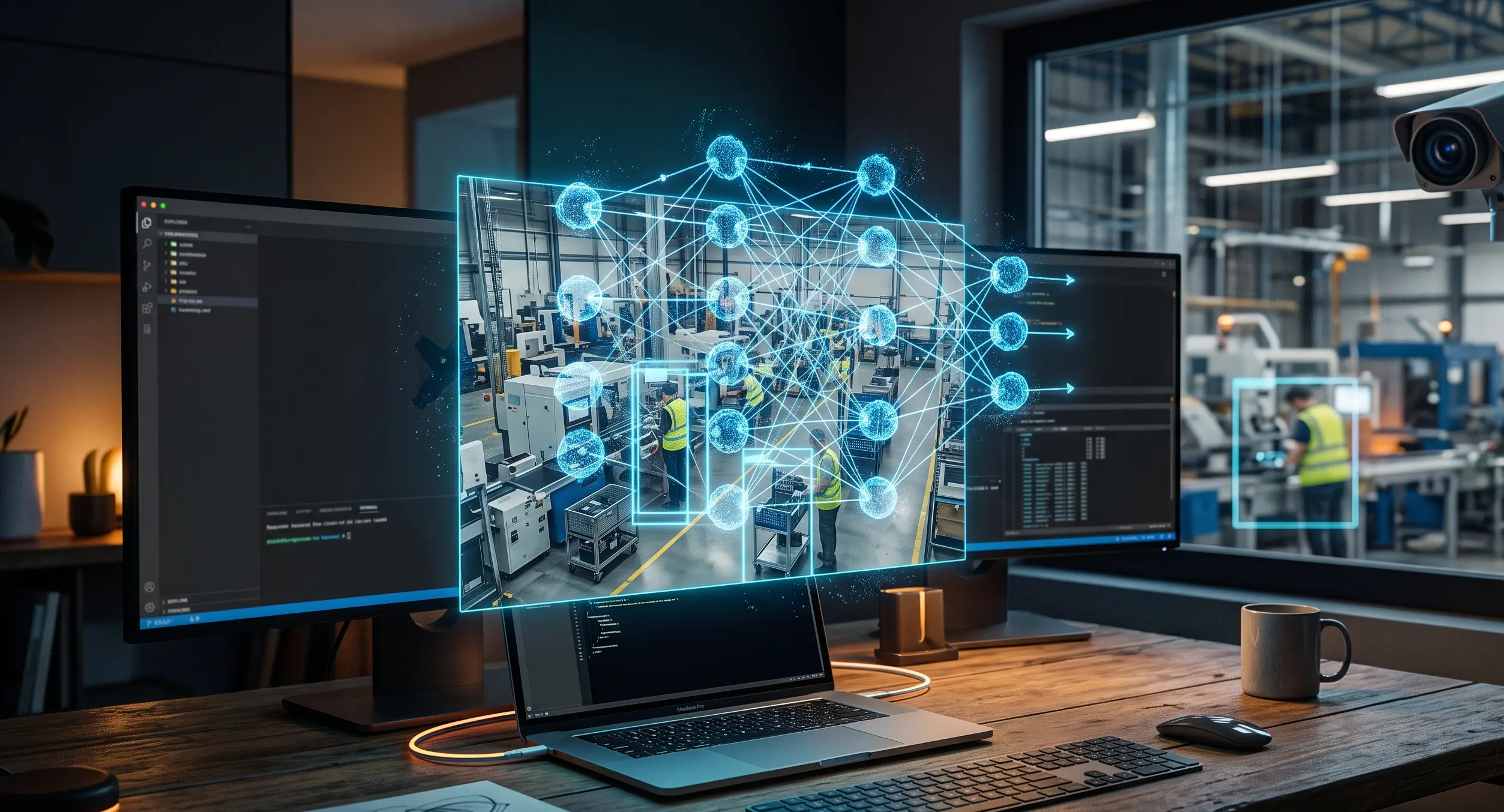
Computer Vision Development Company: What They Do and How to Hire One in 2026
A computer vision development company is different from a company that simply resells an off-the-shelf AI vision product. Development companies build custom models trained on your specific data, integrate them into your existing systems, and support the model as your environment changes, which is exactly the kind of work most real-world deployments actually need, since generic pre-trained models rarely perform well outside a lab environment.
If you're evaluating a computer vision development company for your business, this guide covers what these companies actually do, what the development process looks like, what it costs in 2026, and how to choose a partner who can ship a working system rather than just a promising prototype. Phobolytics is one such company, building custom computer vision systems for clients across multiple industries and regions. You can see a broader breakdown of what computer vision companies do in general in our complete guide to computer vision companies.
What Does a Computer Vision Development Company Actually Do?
Unlike a vendor selling a pre-built, one-size-fits-all product, a computer vision development company works on custom builds, meaning the model, the integration, and the deployment are all shaped around your specific business problem. This typically includes:
Custom model development — building or fine-tuning object detection, classification, or recognition models trained on your actual data
Data collection and annotation — labeling images and video from your real environment so the model learns the conditions it will actually operate in
MVP and proof-of-concept development — validating feasibility with a small, low-risk pilot before committing to a full build
System integration — connecting the trained model to your existing cameras, ERP systems, or security infrastructure via APIs
Deployment and MLOps — hosting, monitoring, and retraining the model over time as conditions or requirements change
The Computer Vision Development Process
Most computer vision development companies follow a similar structured process, even if the terminology differs slightly between providers:
Discovery and scoping — understanding the business problem, existing camera or sensor setup, and what a successful outcome looks like
Data audit and collection — assessing what data already exists and what needs to be gathered or labeled from the actual deployment environment
Model development and training — building a custom model or fine-tuning an existing architecture on the collected data
Testing and validation — measuring accuracy against real-world conditions, not just a curated test set
Integration — connecting the model to the client's existing software and hardware stack
Deployment and ongoing support — monitoring performance in production and retraining as needed
This is the same calibration-heavy approach we use across our own industry deployments — for example, in computer vision quality inspection for African manufacturing plants, where generic models consistently underperform until they're retrained on the client's actual production-line footage.
Custom Build vs. Off-the-Shelf: Which Do You Actually Need?
Not every business needs a fully custom computer vision development company. The right choice depends on how standard your use case is:
Off-the-shelf tools work reasonably well for common, well-documented tasks like generic facial recognition or standard barcode scanning, where the underlying problem is nearly identical across every customer.
Custom development is usually necessary when your environment, object types, or accuracy requirements are non-standard — for example, detecting a specific type of product defect, working with unusual lighting conditions, or integrating with legacy systems that off-the-shelf tools don't support.
Many businesses start with an off-the-shelf pilot to validate the concept, then move to a custom-built system once they understand their specific accuracy and integration needs. This is a similar logic to the build-vs-buy tradeoff covered in our comparison of dedicated AI engineers versus in-house hiring.
How to Choose the Right Computer Vision Development Company
Since development work is inherently more bespoke than buying a packaged product, vendor selection matters even more here. Look for:
A portfolio of similar custom builds — not just industry logos, but specific examples of models built for problems similar to yours.
In-house data annotation and labeling capability — this is often the most time-consuming part of a project, and outsourcing it separately adds delay and coordination overhead.
Clear MLOps and retraining practices — ask how the company monitors model performance after launch and how retraining is handled as your data or environment changes.
Hardware and integration flexibility — confirm they can work with your existing cameras and software stack, not just a specific hardware ecosystem they're partnered with.
Realistic timelines — be cautious of any vendor promising a fully custom, production-ready model in just a few days; proper data collection and validation takes real time.
Transparent, milestone-based pricing — development projects should have clear checkpoints (MVP, pilot, full deployment) rather than one large upfront cost with no visibility into progress.
For broader vendor evaluation criteria across specific industries and regions, see our guides to computer vision companies in Kenya, the top computer vision companies in South Africa, and computer vision for fintechs and banks.
How Much Does Custom Computer Vision Development Cost?
Development costs depend heavily on how custom the build is, how much data needs to be collected and labeled, and how complex the integration is. In general, businesses should budget for:
Proof-of-concept or MVP projects — lower cost, focused on validating feasibility with a limited dataset before committing further
Custom model development for a single use case — moderate investment, covering data collection, model training, and initial integration
Full production deployment with ongoing MLOps support — higher investment, but includes continuous monitoring, retraining, and scaling across multiple sites or cameras
For a detailed regional cost comparison, see our full computer vision cost breakdown for Africa in 2026, which helps set realistic budget expectations before requesting development quotes.
Not sure what your project would cost to build? Get a free consultation and cost estimate from Phobolytics →
Why Custom Development Is Becoming the Default Choice
As computer vision adoption spreads into more specific, non-standard use cases, unique defect types, unusual environments, niche compliance requirements, off-the-shelf tools increasingly fall short. Global research from Grand View Research on the computer vision market points to accuracy and customization as key drivers of continued market growth, since generic models struggle to generalize across the full range of real-world deployment conditions. This is pushing more businesses toward computer vision development companies that can build and calibrate models specifically for their environment, rather than adapting their operations to fit a generic product.
Final Thoughts
A computer vision development company is the right choice when your use case doesn't fit neatly into an off-the-shelf product — whether that's due to unusual environmental conditions, specific accuracy requirements, or the need for deep integration with existing systems. The right partner will have a proven process for data collection, model training, and long-term support, not just an impressive one-off demo.
Phobolytics builds custom computer vision systems across manufacturing, retail, banking, logistics, agriculture, and security, with deployments calibrated to each client's actual environment. If you're evaluating a custom build, our team can walk you through what's realistic for your specific use case, timeline, and budget.
Request a free consultation for your computer vision development project →
Frequently Asked Questions(FAQs)
1. What is a computer vision development company? It's a company that builds custom AI vision models trained on your specific data and environment, rather than selling a generic, pre-built product covering everything from data annotation to model training, integration, and ongoing support.
2. How is a computer vision development company different from a computer vision company? The terms overlap, but "development company" typically implies custom-built solutions tailored to your specific use case, while some computer vision companies focus more on packaged, off-the-shelf products. Many providers, including Phobolytics, offer both.
3. How long does custom computer vision development take? A proof-of-concept or MVP can often be validated within a few weeks, while a full custom model with proper data collection, training, and integration typically takes a few months depending on complexity.
4. How much does it cost to build a custom computer vision system? Costs depend on how much data needs to be collected and labeled, model complexity, and integration requirements. See our regional cost breakdown for detailed ranges.
5. Do I need a custom-built model, or will an off-the-shelf tool work? Off-the-shelf tools work well for standard, well-documented use cases. Custom development is usually necessary when your environment, object types, or accuracy requirements are non-standard.
6. What is data annotation, and why does it matter for computer vision development? Data annotation is the process of labeling images or video so a model can learn to recognize specific objects or patterns. It's often the most time-consuming part of a project, and the quality of annotation directly affects model accuracy.
7. Can a computer vision development company integrate with my existing software and cameras? Yes, a capable development company will build the model to work with your existing camera infrastructure and connect to your existing software systems via APIs, rather than requiring a full technology replacement.
8. What is MLOps, and why does it matter after deployment? MLOps refers to the ongoing monitoring, maintenance, and retraining of a model after it's deployed. Since real-world conditions change over time, models need periodic updates to maintain accuracy.
9. How accurate are custom-built computer vision models compared to generic ones? Custom models trained on your actual environment and data typically outperform generic, off-the-shelf models, especially in non-standard conditions like unusual lighting, camera angles, or region-specific objects and faces.
10. What industries use computer vision development companies? Manufacturing, retail, banking and fintech, logistics, agriculture, and security are among the most common industries commissioning custom computer vision builds, though the approach applies to virtually any industry with a non-standard visual detection problem.
11. Should I start with an MVP before committing to a full build? Yes, in most cases. Starting with a small proof-of-concept validates feasibility and accuracy on a limited dataset before committing to the cost and timeline of a full production deployment.
12. What questions should I ask before hiring a computer vision development company? Ask for examples of similar custom builds, how they handle data annotation, what their MLOps and retraining process looks like after launch, and how pricing is structured across each project milestone.
13. Can a computer vision development company help across multiple industries and use cases? Yes. Many development companies, including Phobolytics, work across manufacturing, retail, banking, logistics, agriculture, and security, applying the same core development process to different use cases and environments.
14. How do I get started with a computer vision development company? Most providers begin with a short discovery call to scope the problem, followed by a small proof-of-concept project to validate feasibility before committing to a full custom build. You can request a free consultation to start the process.