
Computer Vision Agriculture Africa Farms: Proven 2026 ROI for Real Sites
A farm director in Nigeria can lose a whole harvest season because early signs of disease, water stress, or pest damage go unnoticed until fields are already ruined. The usual pattern is familiar: inspections happen too late, decisions are reactive, and the loss is accepted as “normal.” That is not a farming problem. It is a visibility problem.
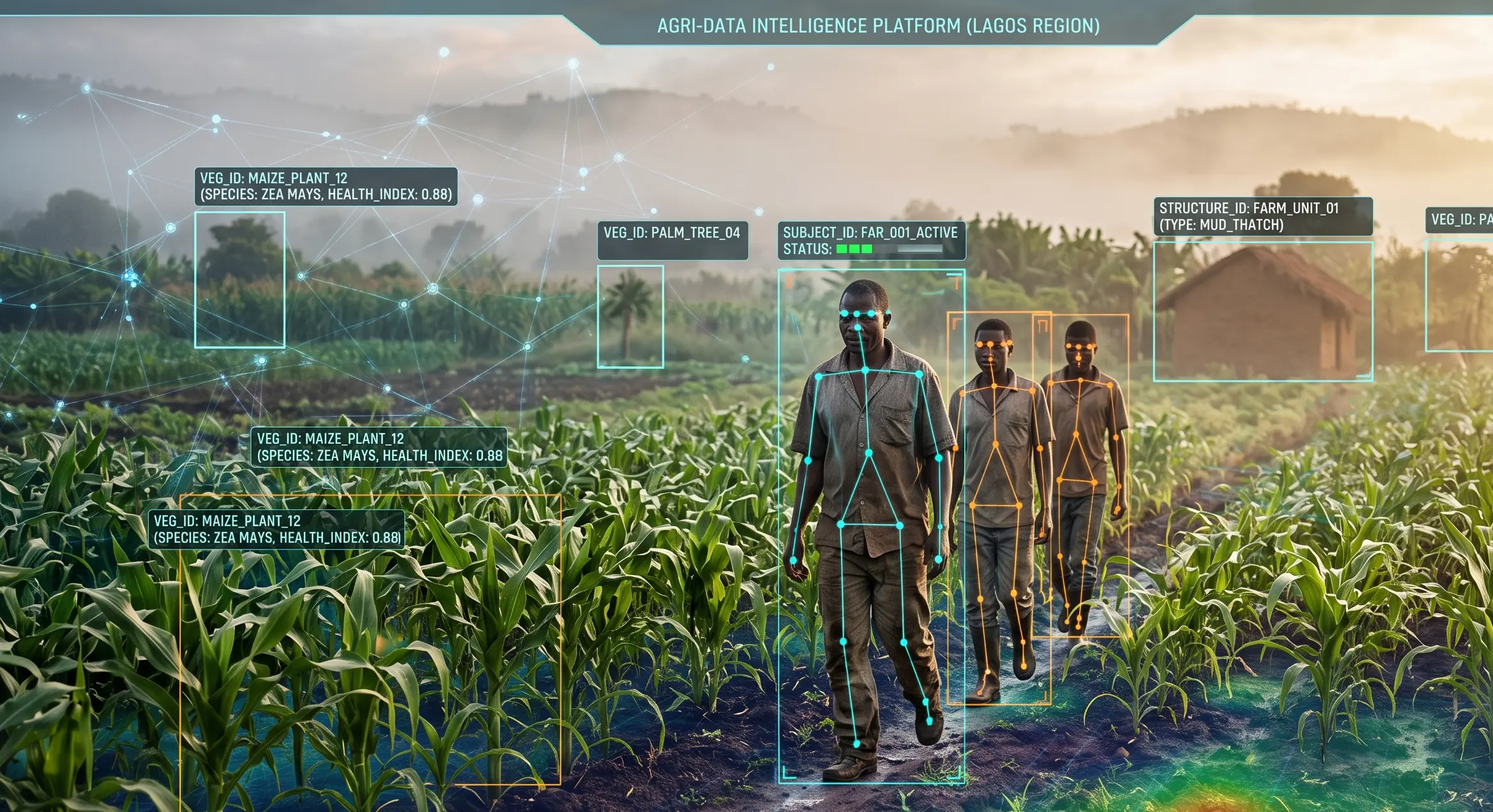
Computer vision agriculture Africa farms changes that by turning existing cameras and sensors into always-on crop monitors that detect anomalies before they become field-wide failures. Operators at medium and large farms in Nigeria, Kenya, South Africa, and Ghana can now see crop health, safety compliance, and logistics issues in real time. Phobolytics is the expert narrator here: it has seen the same gaps across dozens of African industrial and agricultural sites and knows the operational model that actually works.
Quick Answer
Computer vision agriculture Africa farms uses AI to monitor crops, detect disease, and track safety on-site, reducing loss and improving yield. It works on existing camera infrastructure and can scale to large farms.
At a Glance
Yes, computer vision agriculture Africa farms can be deployed on existing CCTV and mobile cameras without replacing your entire system.
The most effective way to start is to pilot one field or zone with a clear metric like disease detection or PPE compliance.
In Nigeria and Kenya, farms use computer vision agriculture Africa farms to cut crop loss, improve safety, and support logistics for produce distribution.
WHY AFRICAN FARM OPERATIONS HAVE A VISIBILITY PROBLEM
African farm operations often run with blind spots that cost money, yield, and worker safety every season. The root cause is not lack of data, but lack of always-on, structured visibility across fields, storage, transport, and worker zones.
The inspector who only sees after damage appears
The inspector who only sees after damage appears is often the one who creates the largest hidden loss. By the time symptoms are visible to the human eye, the problem has already spread across hectares. This is not a rare case. It is what happens when operations scale faster than oversight.
The irrigation gap that becomes a yield gap
The irrigation gap that becomes a yield gap often starts as a small misalignment in water flow. Over weeks, uneven watering stresses plants, reduces quality, and lowers tonnage per hectare. Farm managers accept this as seasonal variance instead of a monitoring failure.
The logistics delay that spoils fresh produce
The logistics delay that spoils fresh produce begins when loading, routing, and handover are managed manually. Deliveries leave late, routes are guessed, and some produce arrives already damaged. The cost is paid in shrinkage, claims, and lost contracts.
The safety gap on busy farm roads
The safety gap on busy farm roads happens when workers, vehicles, and machinery share space without any automated warnings. Near-misses are recorded informally, incidents are under-reported, and patterns never become visible.
The storage loss that no one measures
The storage loss that no one measures is the most expensive hidden failure. Moisture, pests, and temperature issues in grain or produce storage silently reduce quality until the batch is rejected.
Is your current system catching issues before they become field-wide failures?
COMPUTER VISION USE CASES FOR AFRICAN FARMS IN 2026
Computer vision agriculture Africa farms brings real-time monitoring across fields, storage, logistics, and worker zones. Each use case is designed to prevent a known failure mode and to make losses measurable.
Crop health monitoring across large fields
Crop health monitoring uses camera feeds and drone imagery to detect early signs of disease, insect stress, and water problems. Patterns are flagged automatically, and alerts go to the farm team before visible damage spreads.
PPE detection for workers on site
PPE detection uses CV to check whether workers wear required gear such as helmets, gloves, and boots in hazardous zones. Non-compliance is recorded and reviewed, and repeated violations are surfaced to supervisors. Does your current system detect PPE violations in real time?
Automated irrigation and water stress alerts
Automated irrigation systems use CV to detect canopy stress and uneven moisture patterns. Alerts tell managers where to adjust water flow, valves, or pumps. This reduces both over- and under-watering.
Pest and disease early detection
Pest and disease early detection identifies small changes in leaf color, texture, and shape that humans cannot see reliably. The system learns baseline patterns and flags deviations as potential outbreaks.
Logistics and fleet monitoring for farm produce
Logistics and fleet monitoring tracks vehicles entering and leaving the farm, verifies load times, and monitors driver behavior. This reduces delays, fuel waste, and spoilage in transit.
Security and perimeter monitoring for farm sites
Security and perimeter monitoring detects unauthorized access, intrusion, and suspicious movement around storage, gate, and field boundaries. Alerts are sent to on-site teams and security offices.
WHAT MANUAL MONITORING MISSES
Manual monitoring cannot match the speed, coverage, and consistency of computer vision agriculture Africa farms. Inspections are periodic, human attention is limited, and many issues are only noticed after they have already caused damage.
Late detection of crop disease
Late detection of crop disease allows the problem to spread across large areas before any action is taken. The cost is measured in lost yield, higher treatment costs, and lower market value.
Inconsistent safety compliance checks
Inconsistent safety compliance checks mean that PPE violations are missed until an incident happens or an audit exposes the gap. The exposure is both regulatory and reputational.
Hidden losses in storage and transport
Hidden losses in storage and transport accumulate quietly over time as quality degrades and claims increase. The cost is absorbed in lower margins and lost contracts.
COMPARISON TABLE: THREE APPROACHES
Approach | Cost Profile | Coverage Capability | Primary Failure Mode | ROI Timeline |
|---|---|---|---|---|
Manual Monitoring | Low tech cost, high labor cost | Limited, periodic | Late detection, human error | 12–24 months |
Basic CCTV Without AI | Medium hardware cost | Continuous but passive | No alerts, no analytics | 24+ months |
AI Computer Vision via Phobolytics | Predictable monthly cost | Continuous, scalable | Requires clear scope | 6–12 months |
COUNTRY AND SITE VARIATIONS
Different countries and site types shape how computer vision agriculture Africa farms is deployed and where it delivers the most value.
Nigeria: large commercial farms and logistics hubs
In Nigeria, commercial farms near Lagos and Ogun use CV to monitor crop health, manage produce logistics, and enforce safety on-site. Connectivity is often strong in urban zones but weaker in remote fields.
Kenya: horticulture and smallholder clusters
In Kenya, horticulture farms near Nairobi and rural clusters use CV for disease detection, worker safety, and distribution monitoring. Many sites operate with mixed connectivity and mobile-first workflows.
South Africa: industrial-scale agriculture
In South Africa, large commercial farms use CV on high-resolution cameras and drones for yield optimization, safety, and logistics. Infrastructure is more developed, but scale is the main challenge.
HOW TO DEPLOY COMPUTER VISION ON AN ACTIVE FARM SITE
Deployment must protect operations, not disrupt them. The right process turns an active farm into a measurable system without stopping daily work.
Define the primary use case and metric (e.g., disease detection, PPE compliance).
Risk: unclear scope leads to endless pilots with no decision.Map camera coverage across fields, storage, gates, and worker zones.
Risk: blind spots create false confidence in coverage.Choose edge or cloud deployment based on connectivity.
Risk: poor network choice causes delays or lost alerts.Integrate with existing cameras and sensors instead of full replacement.
Risk: new hardware costs slow adoption and ROI.Run a controlled pilot on one field or zone before full rollout.
Risk: launching everywhere at once amplifies errors.Document alert thresholds, escalation paths, and response times.
Risk: undefined rules mean alerts are ignored or misused.
IMPLEMENTATION CHECKLIST — BEFORE YOU GO LIVE
Confirm that cameras cover all critical zones.
Verify that network capacity is sufficient for expected load.
Test whether alerts trigger correctly in real conditions.
Confirm that the team knows who owns each alert type.
Verify that data is stored with clear retention and access rules.
Test whether the system handles low-light and dust conditions.
Confirm that CV models are trained on local crop varieties.
Verify that the platform integrates with existing workflows.
Test whether the system supports offline or edge fallback.
Confirm that the contract includes support and model updates.
COMMON MISTAKES WHEN DEPLOYING COMPUTER VISION
Starting with no defined use case.
Without a clear metric, the system becomes a generic visualization tool. Define disease detection, PPE compliance, or logistics as the primary goal.Expecting instant results without a pilot.
Skipping pilots means you learn too late, when the system is already live. Test one field first, then scale.Over-customizing before proving value.
Custom features add cost and delay. Prove core value first, then tailor.Underestimating connectivity challenges.
Poor network planning leads to missed alerts and data loss. Choose edge or hybrid models for remote sites.Ignoring operational ownership.
Without clear roles, alerts are ignored. Assign owners and escalation paths.Focusing only on tech, not on process.
Technology without process creates noise. Build rules, workflows, and training alongside models.
WHY PHOBOLYTICS TECHNOLOGIES FITS AFRICAN FARM SITES
Phobolytics Technologies fits African farms that need visibility without heavy new hardware or full-time data teams. The model is built for sites that cannot afford to repeat the same loss season after season.
The operational advantage is not just AI models, but the structure around them. CV on existing camera infrastructure reduces upfront costs and speeds deployment. Edge deployment allows sites with low or intermittent connectivity to run monitoring without depending on cloud uptime. A unified platform for PPE, ANPR, and logistics gives operators a single view of safety, access, and movement.
That matters because many farms do not fail from lack of ambition. They fail from inconsistent visibility and slow response. A farm director in Nigeria, Kenya, or South Africa who wants faster results should think less about buying devices and more about deploying a system that works on real sites. Phobolytics is built for operators who need that difference to be real, not theoretical.
Final Decision
The next 12 months will reward farms that fix their visibility model early and punish teams that keep patching losses reactively. If you keep relying on periodic inspections and manual logs, you will keep losing to the same failure mode: the inspector who only sees after damage appears.
If your farm needs computer vision agriculture Africa farms that actually improves yield, safety, and logistics, talk to Phobolytics about a CV deployment.
Supporting Articles
1. Computer Vision Quality Inspection Africa
Shows how CV reduces defects and improves yield in African manufacturing and agro-processing lines.
2. Computer Vision for Logistics in Africa
Explains how CV tracks vehicles, loads, and drivers to cut spoilage, theft, and delays in farm-to-market logistics.
3. Computer Vision Services in Nairobi 2026
Demonstrates CV for safety, monitoring, and efficiency in industrial sites that mirror large agro-industrial operations.
4. Computer Vision for Security Companies in Africa 2026
Covers AI security monitoring that can protect farms, storage yards, and equipment from intrusion and theft.
5. Top Computer Vision Companies in South Africa 2026
Provides enterprise guidance on selecting CV providers, useful for farms adopting industrial-grade systems.
External Authorities
1. CGIAR – Computer vision for African breeding programs
Shows real CV research applied to African agriculture (sorghum grain counting), supporting claims that CV is already used in African breeding and yield estimation.
2. CGIAR – Data-driven smart tools for crop pests and diseases
Supports AI and data-driven crop disease detection use cases in Africa.
3. PlantVillage – AI for crop disease detection in Kenya
Real-world case study of AI crop monitoring for smallholder farmers in Kenya.
4. Wiley – Challenges of computer vision adoption in Kenyan agriculture
Discusses adoption barriers, infrastructure, and policy issues for CV in African agriculture.
5. FG小米 – AI in Agriculture
Provides 2026 implementation roadmap and practical CV use cases for African agribusinesses and farms.
FAQ
Q: What is computer vision in agriculture?
A: Computer vision uses cameras and AI to analyze images of crops, storage, and workers. It detects disease, stress, and safety issues automatically. This helps farms see problems earlier and respond faster, reducing loss. It works on existing cameras and can be deployed on edge devices for low-connectivity sites.
Q: How does AI crop monitoring help African farms?
A: AI crop monitoring flags early signs of disease, water stress, and pest activity before they become visible to the human eye. This allows farm managers to adjust irrigation, treatment, or harvesting plans sooner. The result is improved yield and lower loss, especially on large or multi-site farms in Africa.
Q: Can computer vision detect crop disease on African farms?
A: Yes, computer vision can detect crop disease by analyzing leaf color, texture, and patterns. Models are trained on local crop varieties to recognize common diseases. Alerts are sent to managers, who can then investigate and treat affected areas before the problem spreads across the field.
Q: How is computer vision deployed on an active farm site?
A: Deployment starts by defining the main use case, mapping camera coverage, and choosing edge or cloud deployment. The system is then integrated with existing cameras, tested on one zone, and scaled across the farm. Operational rules are documented so alerts are owned and acted on consistently.
Q: Does computer vision work on farms with low connectivity?
A: Yes, computer vision can work with edge deployment where models run on local devices instead of relying on cloud servers. This allows alerts and analysis to continue even when internet is unstable. Data can be stored locally and synced later when connectivity improves.
Q: How does computer vision improve safety on African farms?
A: Computer vision improves safety by monitoring PPE compliance, detecting unauthorized access, and tracking vehicle‑worker interactions. It flags violations and near-misses automatically, helping supervisors enforce rules and prevent incidents. This reduces both regulatory risk and reputational damage.
Q: What is the ROI of computer vision agriculture Africa farms?
A: ROI depends on the use case and scale, but many farms see value within 6–12 months. Savings come from reduced crop loss, lower treatment costs, fewer incidents, and better logistics efficiency. The payoff is strongest when the system is tied to clear metrics like disease detection or PPE compliance.
Q: How long does it take to deploy computer vision on a farm?
A: A pilot can be deployed in a few weeks, while a full rollout may take several months. The timeline depends on camera coverage, network planning, and integration with existing workflows. The key is to start small, validate results, and then scale.
Q: Can computer vision help with logistics for farm produce?
A: Yes, computer vision can track vehicles, verify loading times, and monitor driver behavior. This reduces delays, spoilage, and fuel waste. For farms in Nigeria, Kenya, and South Africa, better logistics support faster delivery and higher quality at the point of sale.
Q: How does computer vision support irrigation on African farms?
A: Computer vision supports irrigation by detecting canopy stress and uneven moisture patterns. This helps managers adjust water flow and valve settings more precisely. The result is better water use, reduced waste, and improved yield, especially in areas with limited water resources.
Q: What African regulations support computer vision for safety?
A: African regulations such as ILO occupational safety standards and national mining and agricultural safety rules require monitoring and compliance. Computer vision supports these by providing automated records of PPE use, access control, and incident patterns. This helps farms meet audit and regulatory requirements more easily.
Q: Is computer vision affordable for smallholder farms in Africa?
A: Computer vision can be adapted for smallholder farms by using low-cost cameras and shared infrastructure. The key is to start with a focused use case like disease detection or safety monitoring. For many smallholders, the investment is justified by the reduction in loss and the increase in yield.
Q: Why choose Phobolytics for computer vision on African farms?
A: Phobolytics is chosen for CV on existing infrastructure, edge deployment for low-connectivity sites, and a unified platform for PPE, ANPR, and logistics. This fits farms that need practical monitoring without heavy hardware or large data teams, especially in Nigeria, Kenya, and South Africa.
Q: How does Phobolytics support deployment on active farm sites?
A: Phobolytics supports deployment by working with existing cameras, using edge or hybrid models, and integrating with current workflows. The process starts with a pilot, then scales based on results. This approach reduces risk and ensures the system is usable on real sites.
Q: What farm types in Africa benefit from computer vision?
A: Large commercial farms, horticulture clusters, and logistics hubs in Nigeria, Kenya, and South Africa benefit most. Smaller farms can also use CV for focused use cases like disease detection or safety. The key is to match the technology to the operational need.